Warwick's post-war neighborhoods
Most of Warwick's growth came after World War II, when farmland gave way to subdivisions. Governor Francis Farms is a well-known example, with many of its houses dating to around 1950. Today the city is a patchwork of villages, among them Apponaug, Cowesett, Hillsgrove, Norwood, and Pontiac, each with homes from that era and the decades after.
A house of this age has usually been through several water heaters, a few washing machines, and at least one kitchen or bathroom remodel. Every one of those changes added new connections to older plumbing, and connections are where leaks like to start.
Where water damage starts in Warwick homes
- Water heaters near the end of their life. A tank that begins dripping from the bottom rarely improves. Left alone, it can soak a basement floor or the subfloor of a utility closet.
- Washing machine hoses. Rubber supply hoses turn brittle with age, and a burst hose keeps running until someone closes the valve.
- Finished basements. Plenty of families turned basements into family rooms with carpet, paneling, and drywall. Water from a burst pipe or a sump pump that quits wicks into all of it.
- Frozen lines in crawlspaces and garages. Pipes routed through unheated spaces are at risk during the coldest weeks of the year.
- Aging shower pans and tub drains. Bathroom work done decades ago can start seeping into the room or ceiling below.
Mold Removal in Warwick, RI
Mold in a Warwick house usually starts wherever moisture lingers, and in homes from the post-war decades a few places come up again and again:
- Finished basements. Paneling, carpet, and drywall hide dampness from a slow leak or from condensation on cool foundation walls, so a musty smell may be the only early sign.
- Bathrooms. Older fans are sometimes ducted into the attic instead of outdoors, and aging tub surrounds can let water seep behind them.
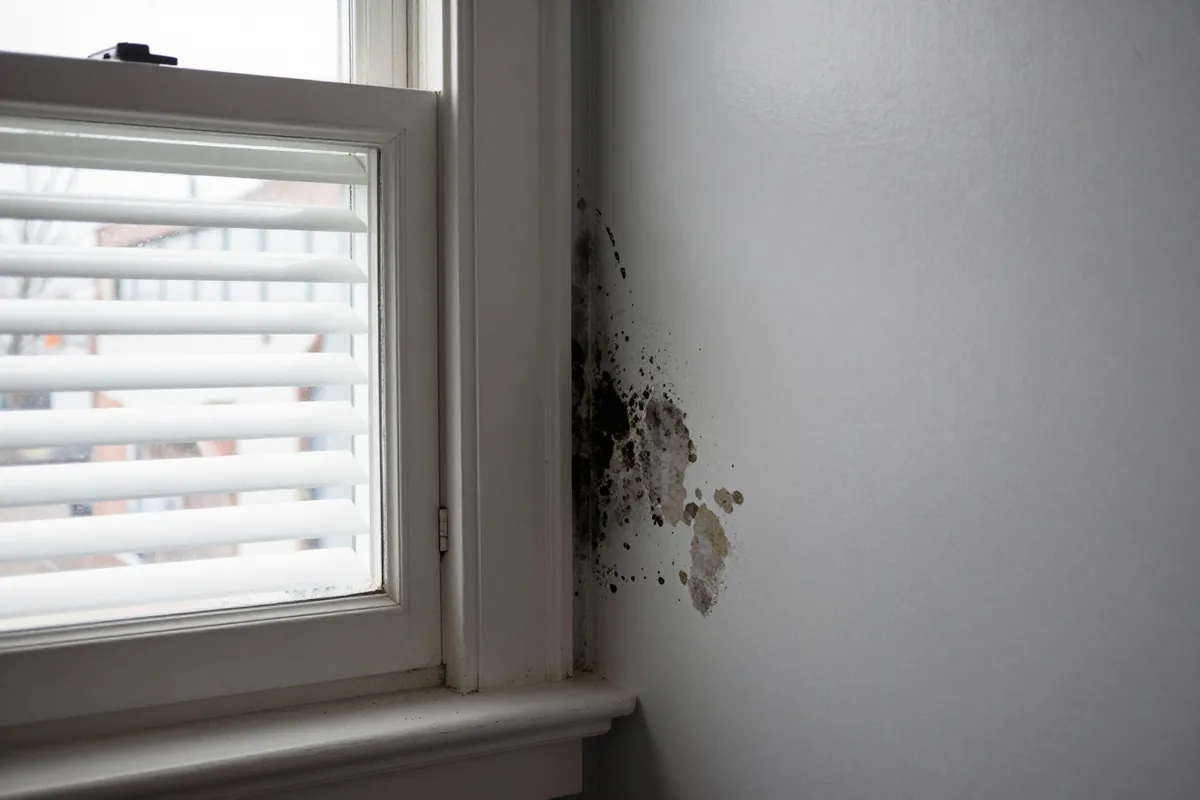
- Around windows. Winter condensation on cold frames can feed growth on the wall beside them, much like the photo on this page.
- Knee-wall attics. If your house has finished rooms tucked under the roof, the narrow spaces behind the knee walls can trap humid air.
- Places that leaked before. The floor around an old water heater, the wall behind the washer, and the cabinet under a sink are worth checking if they ever got wet.
A small patch on a hard surface, well under 10 square feet, is often something you can clean yourself once the moisture problem is fixed. Call a professional if the growth is bigger than that, comes back after cleaning, sits behind paneling or drywall, appeared after water backed up from a toilet or drain, or if anyone in the household has asthma or a weakened immune system. Professional removal usually means sealing off the area, taking out materials that can't be cleaned, and fixing whatever fed the growth. Our mold remediation guide walks through the process, and the mold remediation cost guide shows general national estimate ranges.
What to do first in a Warwick home
- Find the shutoff. The main valve is usually in the basement or utility area where the water line enters. Close it, or close the valve on the appliance that's leaking.
- Cut power to wet areas only if it's safe. Outlets in finished basements sit close to the floor. If water has reached them, switch off the circuit at the panel only if you can get there without stepping in water.
- Pull up what you can. Lift area rugs, move furniture off wet carpet, and get stored boxes off the floor.
- Take pictures of the water, the source, and damaged belongings, then call your insurance company.
- Renting the house? Let your landlord or property manager know before arranging any work.
How the phone line works for Warwick homeowners
This site doesn't send anyone to your house. It runs a phone line, and when you call from Warwick, the line tries to reach an independent business, one of the participating providers, that works in your part of the city. That provider, not this site, inspects the damage, quotes the work, and does it if you agree. Read how the service works.
Planning for cost
A drip under a water heater caught early may be a small job. A finished basement with wet carpet, paneling, and drywall is a larger one, because more material usually has to come out. For general national ranges, see the water damage restoration cost page, and if mold has started, the mold remediation cost page. Your provider sets the actual price after looking at the damage.
Warwick homeowner questions
Is a leaking water heater a plumbing job or a restoration job?
Often both. A plumber repairs or replaces the heater itself. If the water has soaked flooring, drywall, or a finished basement, a restoration provider dries and repairs those materials. Some companies handle both parts; ask when you're connected.
Water got under the carpet in my finished basement. Can the carpet be saved?
Sometimes. Carpet wet with clean water from a supply line can occasionally be dried if work starts within a day or two, though the pad underneath is usually replaced. Carpet soaked by water from a toilet or a drain is generally thrown out.
Mold keeps coming back on my bedroom window frame. What causes that?
Usually condensation. When warm, humid indoor air meets a cold window, moisture collects on the glass and frame and runs onto the wall. Lowering indoor humidity, running bathroom fans, and keeping heavy curtains and furniture away from the window can help. If the mold covers more than a small spot or returns after cleaning, a provider can check for hidden moisture.
What's the difference between water mitigation and water damage restoration?
Mitigation is the first part of the job: stopping further harm by removing the water, drying the structure, and taking out materials that can't be saved. Restoration covers the repairs that follow, such as new drywall, flooring, and paint. Some providers handle both stages, while others do only mitigation and leave rebuilding to a separate contractor.
Nearby city pages
Close to Warwick, there are also guides for: